


The Atom: A Step Toward the Infinitely Small…
Editorial review 2026
The Bohr Atom
We owe the modern description of atomic structure to the Danish physicist Niels Bohr. This description challenged the ideas that prevailed around 1900 and that had been inherited from Greek and Roman philosophers. The atom was imagined as an indivisible and solid abstract object.
The discoveries of the electron, the atomic nucleus, and radioactivity revolutionized this view. It became clear not only that atoms are composed of even smaller particles, but also that they are capable of transforming spontaneously. This profoundly changed our understanding of the laws of physics governing the infinitely small. Thomson’s discovery of the electron led to an initial model of the composite atom in which a matrix of positive electric charge was “embedded” with negatively charged electrons. Rutherford later demonstrated that the positive charge, much more massive than the electrons, was actually concentrated in a very small region at the center of the atom: the atomic nucleus.
Thus, the atom, often imagined as a solid sphere, is in reality composed mostly of empty space. Frédéric Joliot once compared it to “an orange seed placed on the Obelisk of the Place de la Concorde, with specks of dust revolving around it at the distance of the Hôtel Crillon.”
According to this image, if a camera were capable of capturing motion within the atom, it would show a nucleus at the center (the seed), electrons around it (the dust particles), and empty space in between. These tiny electrons move so rapidly that, in a fraction of a second, they travel around the nucleus an enormous number of times. This is why we have the impression that the atom is full. Once it became clear that the atom consisted of a nucleus surrounded by orbiting electrons, a problem arose for classical mechanics: the electrons should radiate energy and collapse into the nucleus. To resolve this issue, in 1913 Bohr proposed that electrons can possess only certain specific energy values; in other words, their energy is quantized. Bohr’s model, later complemented by Schrödinger’s equation, contributed enormously to the development of atomic physics.
Energy Levels and Photons
The Bohr atom is therefore a new world governed by the laws of quantum mechanics. Electrons occupy specific orbits organized into shells. They can move from one shell to another only under certain conditions. When an electron transitions to a lower-energy shell, the excess energy is released as radiation and carried away by a particle known as a photon. Because the energy levels are quantized, the energy of the emitted photons is characteristic of the emitting atom.
New Orders of Magnitude
We often speak of the “infinitely small” when referring to the atomic and subatomic world because the scales involved are vastly different from those encountered in everyday life. These extreme quantities concern the size of atoms, the number of atoms contained in an ordinary object, and the energy associated with atomic processes. For the latter, a suitable unit is used: the electron-volt (eV).
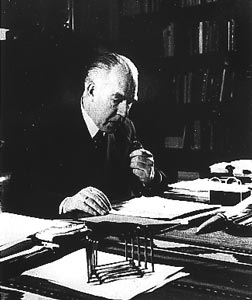
Niels Bohr (1885–1962)
One of the great figures of twentieth-century physics, Niels Bohr was awarded the Nobel Prize in 1922. The Institute for Theoretical Physics in Copenhagen, which he directed until 1962, became the birthplace of some of the most important developments in quantum theory.
DR
And What About Radioactivity?
Radioactivity is a phenomenon of the infinitely small that occurs at the heart of the atom, within the atomic nucleus (described in detail in another section). Like the atom itself, the nucleus has constituents and a structure. It is composed of nucleons: protons and neutrons. Certain combinations of neutrons and protons form unstable nuclei, which spontaneously transform by emitting particles: this is radioactivity.
Moreover, nucleons are organized within the nucleus into different energy levels, much like the electrons in an atom. A transition to a lower energy level within the nucleus also results in the emission of photons, but with energies much higher than those produced by atomic transitions: these are gamma rays.
However, a single nuclear decay or de-excitation releases only a very small amount of energy. The harmfulness of a radioactive sample depends on the number of decays occurring within it each second. To understand these issues, it is important to keep in mind both the extreme smallness of atoms and their enormous numbers.
Articles on the subject « The atomic world »
The Atom
Nucleus and Electrons Editorial review 2026 An atom consists of a nucleus surrounded by a cloud o[...]
The electron
The best known of elementary particles The electron is an elementary particle that plays a fundam[...]
Atomic Energy Levels
A shell structure …. The conquest of space has familiarized us to the concept of a satellit[...]
Photons
The elementary components of light and electromagnetic waves Light is composed of infinitesimal i[...]
Orders of Magnitude
The very small and the very large … The atom, and the nucleus in particular, belong to the [...]
Avogadro’s Number
Trillions of billions of very small atoms …. The microscopic size of atoms comes with their[...]
E=MC²
The Einstein formula, a relation between mass and energy The energy released by a chemical reacti[...]